
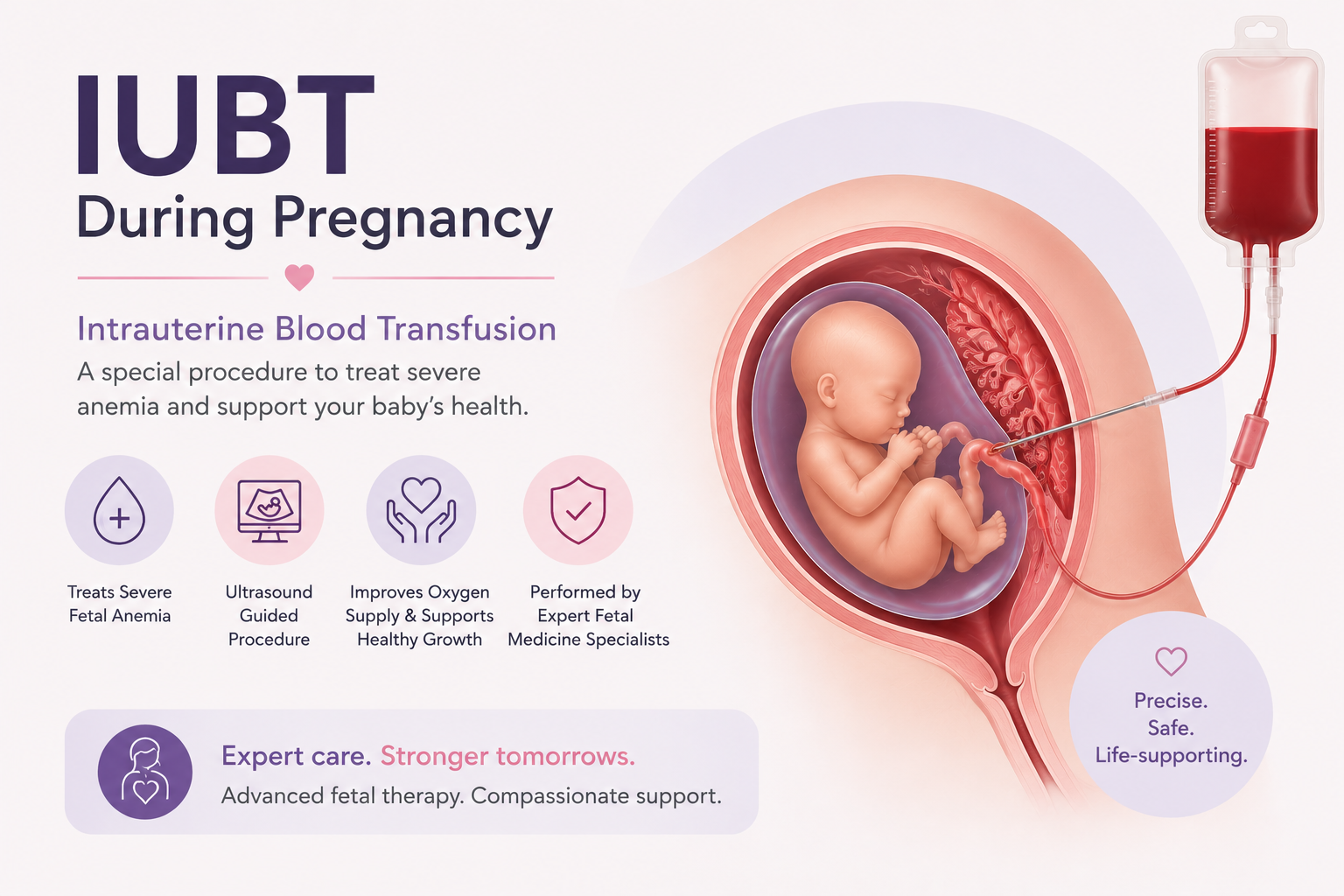
Pregnancy care sometimes requires highly specialized fetal treatments to support the health and wellbeing of the baby before birth. One such advanced fetal medicine procedure is IUBT, also known as Intrauterine Blood Transfusion.
Hearing that your baby may need a procedure inside the womb can feel frightening for parents. However, understanding why IUBT is performed, how it works, and when it may be needed can help families feel more informed and reassured.
With modern fetal medicine and expert monitoring, IUBT has helped improve outcomes in many pregnancies affected by severe fetal anemia.
What Is IUBT?
Intrauterine Blood Transfusion (IUBT) is a specialized fetal procedure in which blood is transfused directly to the baby while still inside the womb.
The procedure is performed to treat severe fetal anemia, a condition in which the baby does not have enough healthy red blood cells.
IUBT is usually performed by an experienced fetal medicine specialist under continuous ultrasound guidance.
Why Is IUBT Needed?
The baby’s red blood cells carry oxygen throughout the body. When severe anemia develops, the baby may not receive enough oxygen, which can affect growth and organ function.
IUBT helps restore healthy red blood cell levels and improve oxygen supply to the baby.
The procedure can help prevent serious complications and support the pregnancy until delivery.
What Causes Fetal Anemia?
Fetal anemia can happen for several reasons, including:
1. Rh Incompatibility
One of the most common causes is Rh isoimmunization, where the mother’s immune system attacks the baby’s red blood cells.
This may happen when:
- Mother is Rh negative
- Baby is Rh positive
- Maternal antibodies affect fetal blood cells
2. Parvovirus Infection
Certain viral infections during pregnancy may affect the baby’s ability to produce red blood cells.
3. Twin Pregnancy Complications
In some twin pregnancies, blood flow imbalance may contribute to anemia in one baby.
4. Fetal Bleeding or Rare Blood Disorders
Some rare fetal conditions may also lead to severe anemia requiring specialized treatment.
How Is Severe Fetal Anemia Diagnosed?
Fetal medicine specialists use advanced ultrasound techniques to assess whether the baby may have anemia.
This may include:
- Doppler ultrasound studies
- Middle cerebral artery (MCA) Doppler assessment
- Detailed fetal ultrasound
- Monitoring for fetal swelling or fluid accumulation
In some situations, additional fetal blood testing may be recommended.
When Is IUBT Performed?
The timing depends on:
- Severity of fetal anemia
- Pregnancy stage
- Baby’s condition
- Specialist evaluation
IUBT may sometimes be required during the second or third trimester depending on the clinical situation.
Some babies may require more than one transfusion during pregnancy.
How Is IUBT Performed?
IUBT is performed in a specialized fetal medicine setting under ultrasound guidance.
During the procedure:
- The mother’s abdomen is cleaned carefully
- Ultrasound is used to identify the baby and umbilical cord position
- A thin needle is inserted through the abdomen into the umbilical cord or fetal blood vessel
- Carefully matched donor blood is transfused to the baby
- The baby is monitored throughout the procedure
The procedure usually takes some time because careful monitoring is essential for safety.
Is IUBT Painful?
Most mothers experience mild discomfort or pressure during the procedure.
Local anesthesia may be used to help reduce discomfort during needle insertion.
Your fetal medicine specialist will explain the procedure step by step before starting.
Is IUBT Safe?
IUBT is a highly specialized procedure and is generally performed only in experienced fetal medicine centers.
Like all invasive fetal procedures, it carries some risks, including:
- Bleeding
- Infection
- Preterm labor
- Changes in fetal heart rate
- Fluid leakage
- Pregnancy complications (rare)
However, in cases of severe fetal anemia, the benefits of treatment may outweigh the risks.
Your specialist will discuss the risks and expected outcomes carefully with you.
What Happens After the Procedure?
After IUBT, the baby is monitored closely using ultrasound and fetal heart assessment.
The mother may also be observed for some time before going home.
Follow-up care may include:
- Repeat ultrasounds
- Doppler monitoring
- Additional transfusions if required
- Ongoing fetal medicine review
The goal is to continue supporting the baby safely throughout pregnancy.
Can Babies Recover After IUBT?
Many babies respond well to intrauterine transfusion when diagnosed and treated appropriately.
Outcomes depend on:
- Cause of anemia
- Severity of condition
- Pregnancy stage
- Overall fetal health
- Timing of treatment
Early diagnosis and expert fetal monitoring play an important role in improving outcomes.
Emotional Support for Parents
Learning that your baby requires a fetal procedure can feel emotionally overwhelming.
Parents often experience:
- Anxiety
- Fear
- Confusion
- Uncertainty about outcomes
It is important to remember that fetal medicine teams are there not only to provide treatment but also emotional support, counselling, and guidance throughout the pregnancy journey.
Clear communication and compassionate care can help families feel more supported during this time.
When Should You See a Fetal Medicine Specialist?
You may need specialist evaluation if:
- There is suspected fetal anemia
- You are Rh negative with antibody concerns
- Ultrasound Doppler findings are abnormal
- Your pregnancy involves fetal infection concerns
- Twin pregnancy complications are present
- Your doctor advises advanced fetal monitoring
Early referral to a fetal medicine specialist can help improve monitoring and treatment planning.
Advanced Fetal Therapy and Expert Care at Mom & Me
At Mom & Me, we understand that pregnancies requiring fetal procedures need both advanced medical expertise and compassionate support. Our fetal medicine specialists provide detailed fetal assessment, high-risk pregnancy care, advanced ultrasound monitoring, and specialized fetal therapy guidance tailored to each pregnancy.
We are committed to helping families feel informed, supported, and cared for throughout every stage of their pregnancy journey.
Book a fetal medicine consultation at Mom & Me for expert evaluation, advanced fetal monitoring, and compassionate pregnancy care.
1. What is IUBT during pregnancy?
IUBT (Intrauterine Blood Transfusion) is a fetal procedure used to treat severe anemia in the baby before birth.
2. Why might a baby need IUBT?
The procedure may be needed when the baby has severe anemia caused by conditions such as Rh incompatibility or fetal infection.
3. Is IUBT a surgery?
No. It is a specialized needle-guided fetal procedure performed under ultrasound guidance.
4. Is IUBT safe?
The procedure is performed by experienced fetal medicine specialists and may help improve outcomes in severe fetal anemia cases, although some risks are involved.
5. Can more than one transfusion be required?
Yes. Some babies may require repeated transfusions depending on the severity of anemia and pregnancy stage.
6. How is fetal anemia detected?
Doctors usually diagnose fetal anemia using specialized ultrasound Doppler studies and fetal assessment.