
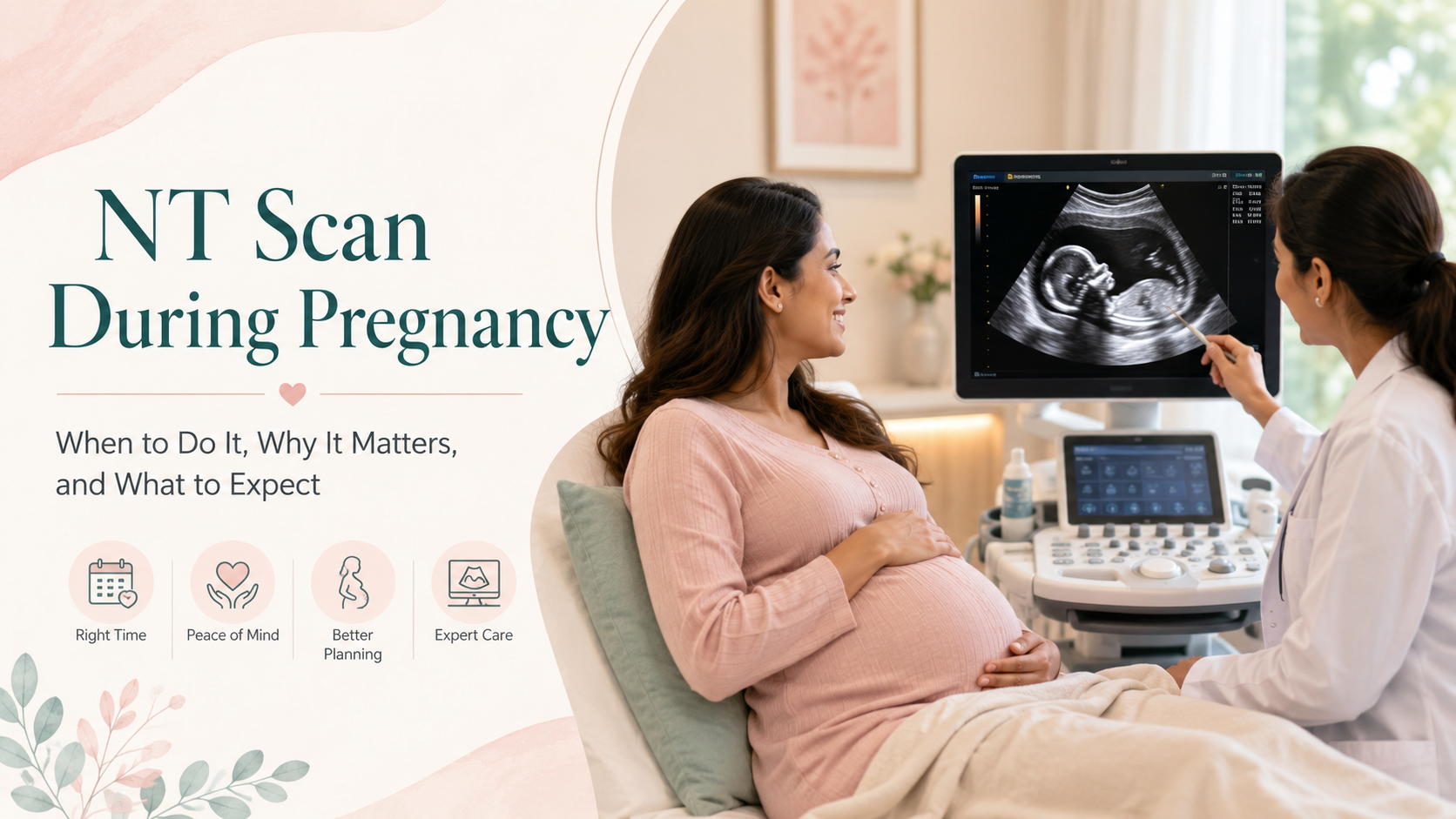
Pregnancy is a beautiful journey, but it also brings many questions for expecting parents. One of the important scans recommended in the first trimester is the NT scan, also known as the Nuchal Translucency scan.
This scan helps assess your baby’s early development and gives useful information about the risk of certain chromosomal conditions. For many parents, it is also one of the first detailed opportunities to see their baby on ultrasound.
What Is an NT Scan?
An NT scan is a specialized ultrasound performed during early pregnancy. It measures the small fluid-filled space at the back of the baby’s neck, called the nuchal translucency.
All babies have some fluid in this area at this stage of pregnancy. However, if the measurement is higher than expected, it may indicate an increased risk of certain chromosomal conditions or other developmental concerns. NT is seen and measured by ultrasound between around 11 and 14 weeks of pregnancy. (ISUOG)
It is important to understand that an NT scan is a screening test, not a diagnostic test. This means it does not confirm whether the baby has a condition. Instead, it helps identify whether further evaluation or testing may be needed.
When Should You Do an NT Scan?
The NT scan is usually done between 11 weeks and 13 weeks + 6 days of pregnancy. This timing is important because the baby needs to be big enough for accurate measurement, but still within the recommended first-trimester window. ISUOG guidance recommends offering the first ultrasound scan when gestational age is thought to be between 11 and 13 + 6 weeks, and NHS guidance describes the dating and combined screening scan as usually taking place between 10 and 14 weeks. (ISUOG) (nhs.uk)
For the most accurate results, expecting parents should not delay booking the scan. Once this window passes, the NT measurement may no longer be useful in the same way.
Why Is the NT Scan Important?
The NT scan plays an important role in early pregnancy screening. It helps your fetal medicine specialist assess:
- Baby’s growth and gestational age
- Baby’s heartbeat
- Number of babies, such as singleton or twin pregnancy
- Early structural development
- Nuchal translucency measurement
- Risk assessment for chromosomal conditions such as Down syndrome, Edwards syndrome, and Patau syndrome
The scan may also be combined with a blood test as part of first-trimester screening. The NHS describes combined screening as involving a blood test along with measurement of the fluid at the back of the baby’s neck. (nhs.uk)
What Conditions Can an NT Scan Help Screen For?
An NT scan can help assess the risk of certain chromosomal abnormalities, including:
Down syndrome, also called Trisomy 21
This is one of the most commonly discussed conditions in relation to NT screening.
Edwards syndrome, also called Trisomy 18
This is a serious chromosomal condition that can affect baby’s growth and development.
Patau syndrome, also called Trisomy 13
This is another serious chromosomal condition that may be screened for during early pregnancy.
An increased NT measurement can also sometimes be associated with structural concerns, including heart-related conditions. If an enlarged NT or anomaly is seen on ultrasound, ACOG recommends that patients be offered genetic counseling, diagnostic testing, and detailed ultrasound evaluation. (ACOG)
What Happens During the NT Scan?
The NT scan is a non-invasive ultrasound. In most cases, it is done through the abdomen. The doctor or sonographer applies gel to the tummy and uses an ultrasound probe to view the baby.
During the scan, the specialist will:
- Check the baby’s position
- Measure the baby from head to bottom
- Confirm the pregnancy dating
- Look at the baby’s heartbeat
- Measure the nuchal translucency
- Assess early visible structures
- Explain whether the findings are within the expected range
Sometimes, if the baby is not in the right position, you may be asked to wait, walk around, or return after some time so the measurement can be taken more accurately.
Does an Abnormal NT Result Mean Something Is Wrong?
Not always.
A higher NT measurement does not mean that the baby definitely has a problem. It only means that the risk may be higher and further evaluation may be recommended.
Depending on the result, your doctor may suggest:
- Repeat ultrasound
- Double marker or combined screening
- NIPT
- Genetic counselling
- CVS or amniocentesis, if required
- Detailed anomaly scan later in pregnancy
- Fetal echo, especially if there is concern about the baby’s heart
The goal is not to create fear, but to give parents clear information and the right next steps.
How Should You Prepare for an NT Scan?
There is usually no major preparation needed. However, these simple tips can help:
- Carry your previous pregnancy reports and scan records
- Know your last menstrual period date, if available
- Wear comfortable clothing
- Reach the scan centre on time
- Ask your doctor whether you need a full bladder
- Come prepared with your questions
Most importantly, book the scan within the correct pregnancy window.
Is the NT Scan Safe?
Yes, the NT scan is an ultrasound-based screening test and is considered safe when performed by trained professionals for medical purposes. It does not involve injections, radiation, or surgery.
At Mom & Me, scans are performed with care, comfort, and clear communication so that expecting parents feel informed throughout the process.
Who Should Consider an NT Scan?
The NT scan is commonly recommended for pregnant women in the first trimester. It may be especially important if:
- You want early reassurance about your baby’s development
- You are above 35 years of age
- You have a previous pregnancy with chromosomal abnormality
- There is a family history of genetic conditions
- You are carrying twins or multiples
- Your doctor has advised first-trimester screening
- You want to understand your baby’s risk profile early
However, every pregnancy is unique. Your gynecologist or fetal medicine specialist can guide you based on your individual condition.
NT Scan vs Anomaly Scan: Are They the Same?
No, they are different scans done at different stages of pregnancy.
The NT scan is done in the first trimester, usually between 11 and 13 weeks + 6 days. It focuses on early screening, pregnancy dating, and nuchal translucency measurement.
The anomaly scan is usually done in the second trimester and gives a more detailed evaluation of the baby’s organs and physical development.
Both scans are important, but they serve different purposes.
When Should You Book Your NT Scan?
Ideally, you should plan your NT scan as soon as your pregnancy reaches around 11 weeks. Since there is a limited window for accurate NT measurement, early booking helps avoid missing the recommended timeline.
If you are unsure about your pregnancy week, speak to your doctor or contact Mom & Me for guidance.
Book Your NT Scan at Mom & Me
At Mom & Me, we understand that every scan is more than just a medical appointment — it is an emotional moment for parents. Our fetal medicine team focuses on accurate assessment, gentle care, and clear explanation at every step.
If you are between 11 and 13 weeks + 6 days pregnant, this is the right time to schedule your NT scan.
Book your NT scan at Mom & Me today and take an important step toward informed, confident pregnancy care.
Frequently Asked Questions
1. Is the NT scan compulsory during pregnancy?
The NT scan is commonly recommended as part of first-trimester screening, but your doctor will guide you based on your pregnancy and medical history.
2. Is the NT scan painful?
No. It is a painless ultrasound scan. You may feel slight pressure from the probe on your abdomen, but it is generally comfortable.
3. How long does an NT scan take?
The scan usually takes around 20 to 30 minutes, but it may take longer if the baby’s position makes measurement difficult.
4. Can the NT scan detect Down syndrome?
The NT scan can help assess the risk of Down syndrome, but it cannot confirm it. If the risk is high, your doctor may recommend further screening or diagnostic tests.
5. What if I miss the NT scan window?
If you miss the recommended NT scan period, your doctor may suggest other screening options depending on your pregnancy stage.
6. Do I need a blood test with the NT scan?
In many cases, the NT scan may be combined with a blood test for better risk assessment. Your doctor will advise whether it is needed for you.